Friday, January 22, 2016

Professional Learning for Educators

Inquiring minds want to know what really happens on a full day of professional learning across the District. Monday, January 18 was chocked full of differentiated professional learning for all educators in the Ames Community School District.  Here’s a little insight as to what happened with several of the different groups.


Northwood
Our day of learning at Northwood was spent expanding our understanding of the components of a Quality Early Childhood Literacy program. Principal, Brandon Schrauth, began the day by modeling the different Intentional Teaching Structures for Early Literacy in Reading, Writing and Oral Language. Mentor teacher, Kendra Wuestenberg, spoke on the topic of Phonological Awareness and how to increase our understanding and teaching of the vast array of skills that encompass it. Model teacher, Nichole McCrady, taught us about Alphabetic Principle and different ways to infuse alphabet work into our half-day programs. Instructional Coach, Johanna Hicks, lead a discussion around comprehension and how we can teach our students how to think within, about and beyond text that is read to them. Model teacher, Alicia Ortner, finished each presentation by fostering conversations about we can engage ALL learners by embedding these strategies into our regular classroom activities. Each presenter ended their discussions with a make and take time for teachers to use the knowledge they learned to prepare items for use in their classroom.
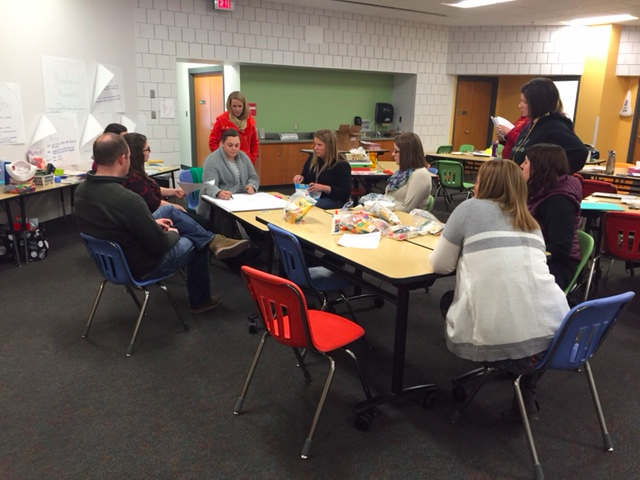
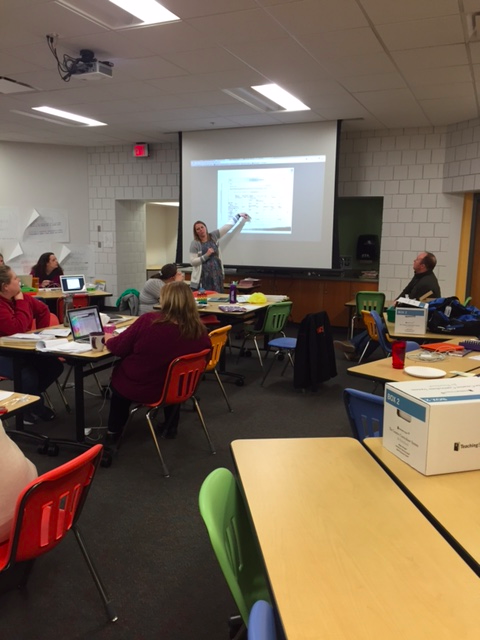
Make and Take time!         Alicia Ortner explaining Nichole McCrady explaining 
modifications for the classroom       Alphabetic Principle

Elementary
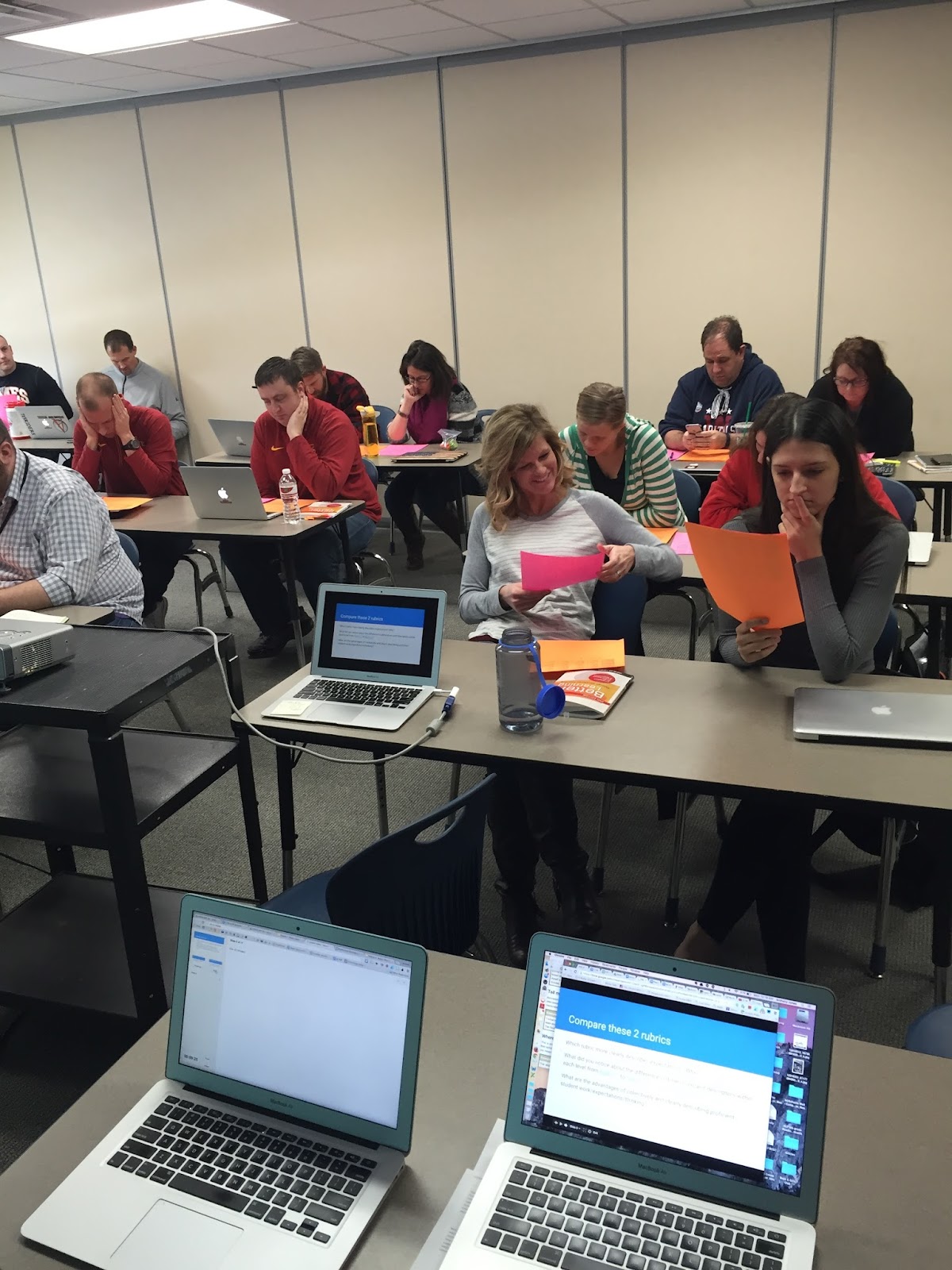
Calibrating understanding of how endurance, leverage and readiness play into determining what standards are most essential to teach until mastery for our students was the hot topic of the morning for all K-5 teachers.  The Teachers on Special Assignment for the District led the different grade levels and started the discussion by sharing the history of Essential Standard work in the past and the vision for this work in the future.  Grade level teams reflected on data around the number of reading and math essential standards currently chosen as well as whether or not we had alignment in which standards are being taught in the classrooms.

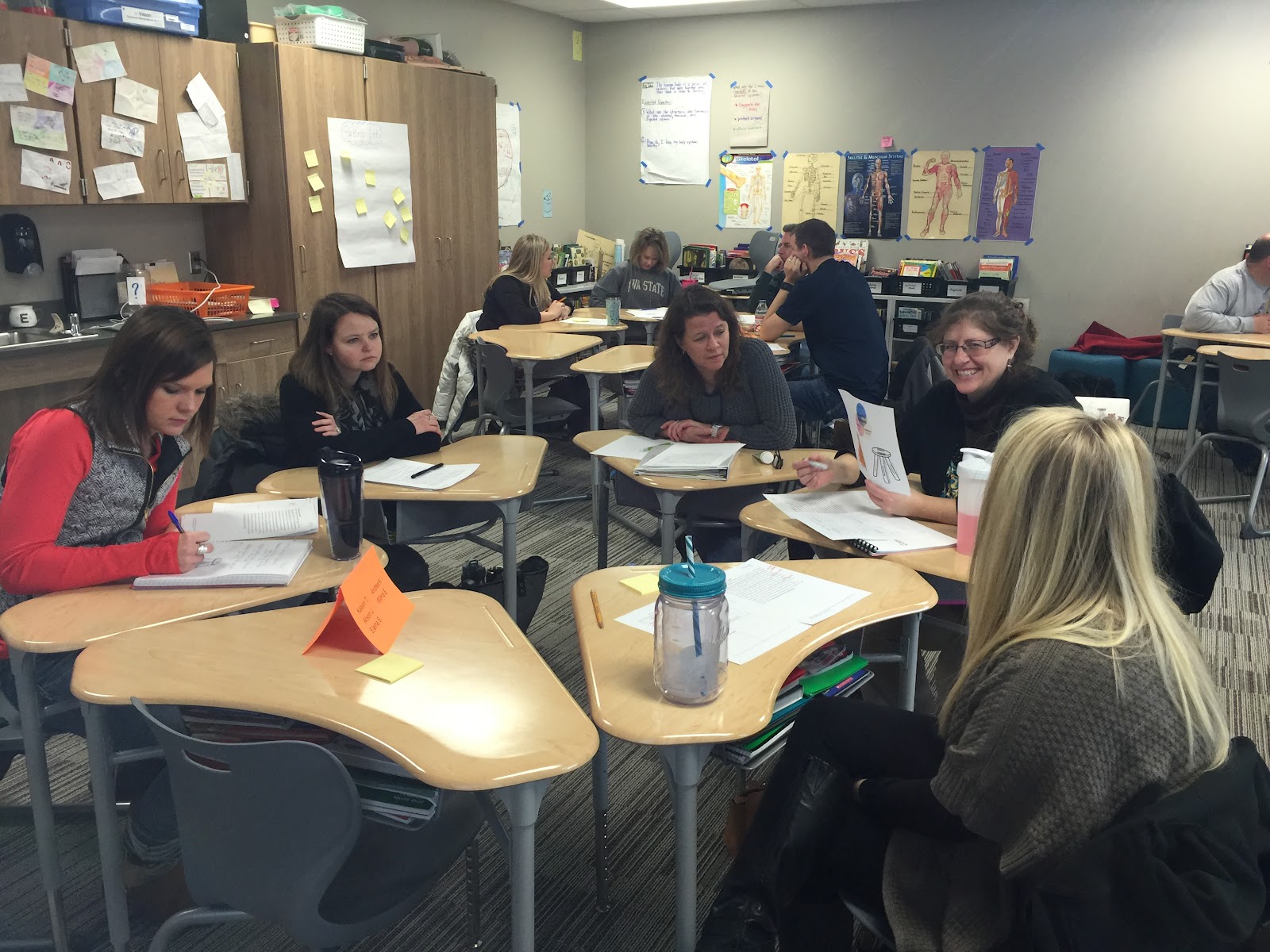
IMG_0518.JPG IMG_0519.JPG

A portion of text from Common Formative Assessments by Kim Bailey and Chris Jakicic was used to ground us in what the experts say on this topic.  Following that learning, teams of teachers practiced using a rubric to force rank selected reading and math CCSS standards by looking at the amounts of endurance, leverage, and readiness they have. The morning ended with PLCs using their new learning and common language to re-examine their essential standards.  This work will be instrumental in moving us down the road towards creating District Level Essential Standards.

Middle School
Our professional learning opportunities for middle school staff began with a Rare Birds activity to kick off a morning of collegiality and learning.  Staff learning in the areas of digital citizenship, common formative assessment, rubric creation, and analyzing data followed. One of the highlights of the morning was the opportunity to watch and reflect on John Hattie’s Ted Talk, Why are So Many of our Teachers and Schools so Successful?

This video provided staff with insight as to why when we work together in a collective effort, our students respond with greater academic success and growth. We continued our learning with a refresher on the PLC flow chart and broke out into one of three differentiated sessions:  


  • Creating a focused and reasonable, common formative assessment
  • Creating a quality rubric to describe proficient student work
  • Analyzing and responding to common formative assessment data
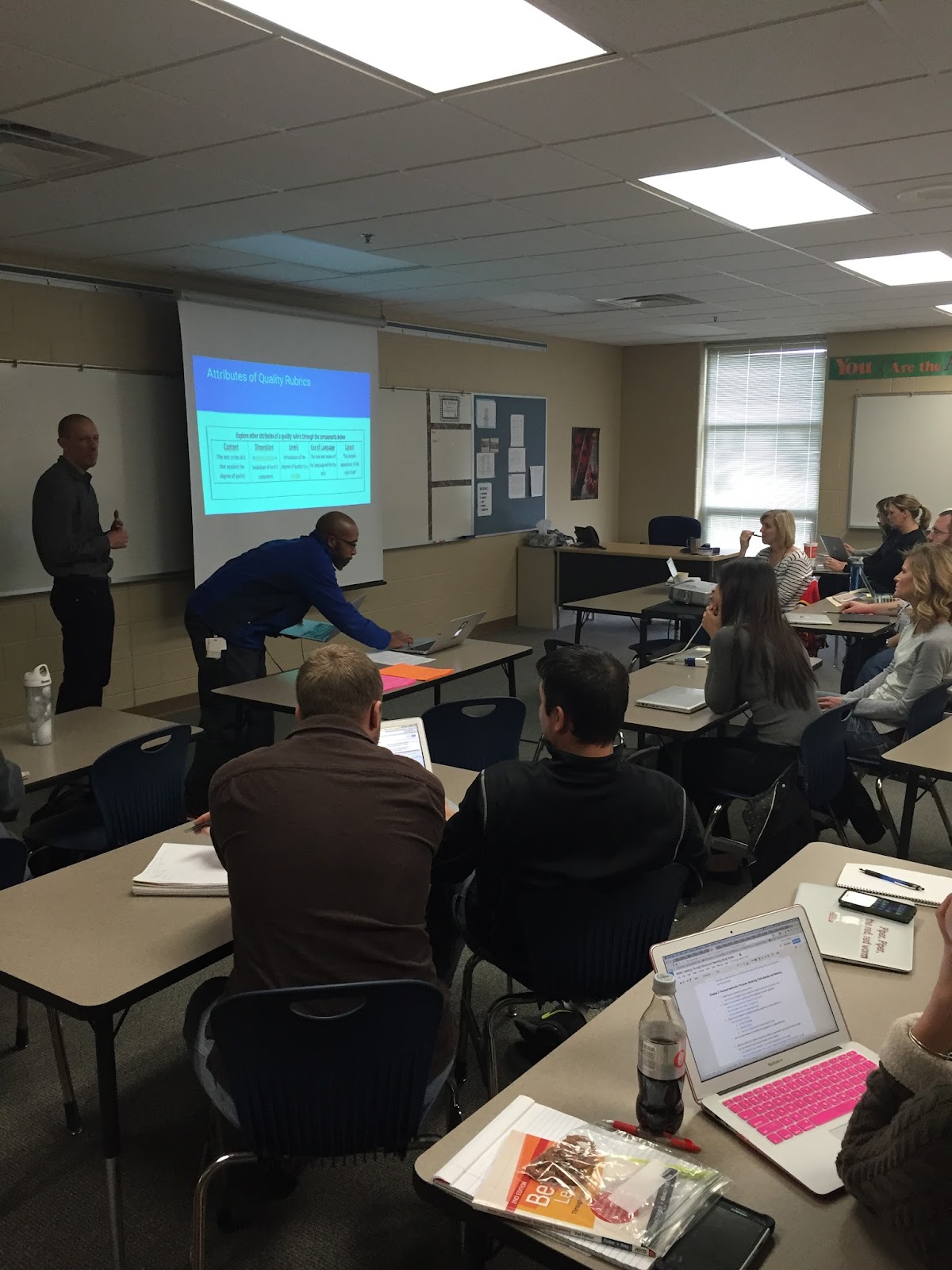
 
IMG_1664.JPGIMG_1665.JPG

PLC’s came together in the afternoon to share their takeaways from the morning, and continue down the path of collaborative work. There are some truly great things happening at Ames Middle School. The staff is passionate about the work they are doing. The continued development and growth of PLC’s at Ames Middle School is evident in the conversations amongst teaching staff. It is an exciting time at AMS!

High School
Professional development has focused on core area teachers planning a mental model to share with their students of how they construct meaning “when the text is difficult and the task matters.” The learning outcome for this mental model was for students to observe their teacher constructing meaning from a passage of which they had little to no background knowledge.


While all teachers engage in explaining, analyzing, and/or interpreting complex text for students, we acknowledge that we do not always show students how we think about the text to reach these explanations, analyses, and/or interpretations. Through observing an expert reader in their particular subject area, students should be able to “see” the invisible process of creating meaning from complex text.

Prior to Monday, model teachers Ginny Seibert, Leah Stearns, Instructional Coach Katie Gustafson, and Ben Matthies provided a model for teachers in their respective departments of what a mental model looked and sounded like. On Monday, teachers worked in large, departmental groups to discuss necessary background information about modeling for students; individual teachers then set up times to meet one-on-one with the Instructional Coaches to work collaboratively in constructing a thorough mental model. These mental models were then presented to students in their core classes on the Tuesday and Wednesday prior to the start of the Iowa Assessment tests.

Speciality Areas
Music
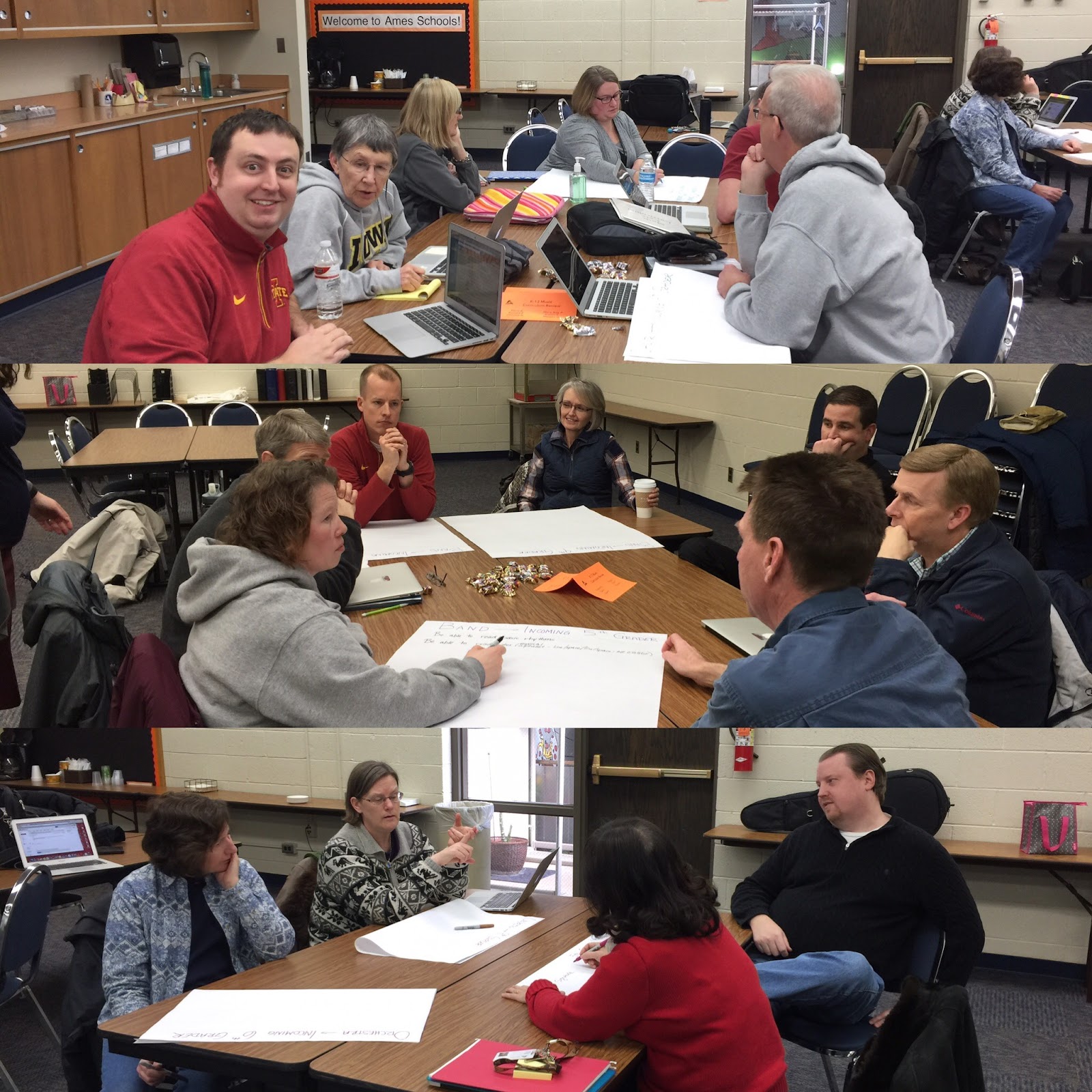
IMG_0530.JPGMusic educators in Ames gathered as a K-12 team in order to strengthen their common vision for music education in Ames. After spending time outlining the skills students need in order to be successful in band, orchestra, general music and choir, teachers worked together to outline the benchmarks at for elementary, middle and high school students. Moving forward, teachers will be revising their grade and course level expectations, revising assessments, and exploring new materials to use with student musicians. These teachers’ passion and dedication to serving students is truly inspiring.

Family and Consumer Sciences
The Ames Middle School and Ames High School teachers of family and consumer sciences met together to share some learning and strengthen the alignment of their programs.  They spent time reading the Financial Literacy Work Team Report from 2014 and studying the 21st Century Skills for Financial Literacy. They shared essential standards and activities for teaching financial literacy. They are passionate about educating all students in the Ames Community Schools in the financial skills necessary for living and working in the 21st Century.

Art 
Submitted by Susan “Coach” Norris
Art teachers met as a K-12 PLC and were lead by TOSA Mary Morton. Mary divided us into groups with elementary, middle school and high school teachers in each group. We began group work by sharing one portfolio item and process with each other. High school art teacher Lindsay Wede shared examples of photo essays created by Photography 1 students followed by Sara Knutson sharing watercolor landscape works by 6th graders. Laurie Olk presented examples of self-portraits created by K-5. I shared a Powerpoint created for grades 3-5 to introduce a TAB (Teaching Artistic Behaviors) concept. Mary then presented a rubric to help compare the Iowa Core Companion document and the National Core Arts Standards with our current course level expectations for elementary, middle school and high school levels of learning. We considered the purpose, level of alignment to best practice, as well as positives and negatives for each document. Working on and discussing the rubric allowed the K-12 art PLC to formulate a recommendation we can share with the School Board regarding ongoing work with curriculum. Each level has scheduled work days over the next three months to formulate Curriculum Review Action Plans.

PE
Physical Education teachers met for the second time on Monday to continue to align their work with students to a K-12 vision.  The discussion began with a review of the essential components of physical education, policy / environment, curriculum, instruction, and assessment.  Studying the National Standards for Physical Education collaboratively in mixed and PLC teams fostered great conversations that ranged from assessment and grading practices to student behaviors.  Always an enthusiastic group, the PE teachers showed dedication, passion, and commitment to their students and each other.  These teachers are now in the process of creating PLC level action plans to channel that work for Ames students.


Monday, January 11, 2016

Putting Students First - The Power of Vertical Conversations

“If your actions inspire others to dream more, learn more, do more and become more, then you are a leader.” - John Quincy Adams 


Teacher leadership can take many different forms. At Kate Mitchell, all teachers are joining together to become leaders for each other and for their students as they work to strengthen their PLCs through vertical conversations.
 
Four years ago, the spirit of PLCs and collaboration began to invade the hallways at Mitchell. Since then, teachers have aligned their understanding of the Common Core within grade level teams. Over the past four years, teachers have taken professional days with coaches, collaborated over the summer, and reflected as PLCs to refine their understanding of the rigor of the essential standards they are teaching.


With clear horizontal articulation of essential standards and assessments in each PLC, this year Mitchell teachers began to have vertical conversations. Using a format similar to one that was found on Steve Barkley's Blog, Kate Mitchell staff began processing, sharing and reflecting in groups with grade levels above and below. Conversations were guided by essential questions. Teachers shared grade level essential standards and examples of an assessments.  Deep thinking across grade levels ensued as they negotiated, found similarities, and extended their thinking on their practices as a result of sharing and reflection.


As a result of these conversations, teachers came to powerful realizations. Some teachers recognized the great work their peers are doing. “Shout out to second grade about all the differentiation they are providing for their kids,” said third grade teacher Amanda Kabrick. Second grade teacher Marie Shipley added, “I didn’t know third grade was using power points as a part of their lesson, and I want to try that.”


In addition to this recognition, the direction of future conversations also became clear. Fifth grade teacher Elaina Soulek wants “to continue meeting so we can look at rubrics and the standards to continue building off of the fourth grade skills.” Aligning work to other grade levels allows teachers to better understand the rigor of the standards at their own grade levels.

Another teacher, first grade teacher Heather Spalding, also realized the value in working vertically: “The fact that kindergarten is using the term ten frames is making the world of difference this year.”

Charlyn Mason, a kindergarten teacher, also sees value in continuing to meet. She reflected: “Both times we have met, I have walked away thinking of the importance of using the same language. That’s the next step we need to go schoolwide.”

The passion each of these teachers demonstrated throughout these vertical conversations inspired colleagues to learn more, to do more, and to become more so that all students can be successful. The leadership these teachers demonstrated during these conversations is a springboard for the future. As the year progresses, these conversations will continue. So will the spirit of collaboration, cooperation, and leadership that reminds us that all kids are our kids.

Monday, December 14, 2015

Student Choice


We know that all students do not all learn in the same way, or at the same time.  Technology has made it easier to give students more options when it comes to how they learn and how they show their learning.  We have access to a large number of resources and tools so we can allow students to have more options when it comes to what and how they learn.  Part of that includes giving students the ability to take ownership of their learning through choice, and also making sure they have the ability and knowledge to make good use of that choice.


Mentor Teacher, Kate Engelkes, recently was a featured speaker at the Iowa Technology Education Connection (ITEC) Conference in October.  One of her presentations was titled “The Power of Choice: Building Learning Efficacy in Students.”  Kate has added student choice into her classroom through the use of the Gradual Release of Responsibility as a way to help her students make use of the choice they have in their learning.  Kate has found her students are more engaged and empowered when they have choice in their learning.  Students have gone beyond the basic requirements and have produced some great artifacts of learning.


Adding student choice can be accomplished by starting small and building up over time.  It may take time for both teacher and students to become comfortable with this, as it can be very different than what they are used to.  The goal is to help students become true owners of their learning. Giving students the choice of resources they use, beyond the textbook, is a good start for many. Students may learn better through reading different types of explanations or through using different types of media.  The goal should be to give students the ability to choose what will work best for them.

http://www.newbeginningswithgina.com/wp-content/uploads/2014/09/power-of-choice.jpg

What Kate has done in her classroom is to acknowledge that she does not have to be the expert of the tools that her students use.  Giving students the option to pick how they show their learning during projects or other activities means you allow them to select options that may be outside of your expertise.  Students may want to create something, or use a tool that they are more knowledgeable about, and they may find it easier to express what they have learned using this tool or technique.  Sometimes the method, or tool, that we choose may not be the best way for that student to show their learning or keep them actively engaged in their learning. Giving them choice is a way to keep the students engaged and allows them to truly own the learning.  


A key to ensuring that student choice leads to improved learning is to build in a way for students to reflect about how their choices and work affected their learning.  Reflecting can lead to new discoveries about how we learn and can help us become better learners. Kate includes many opportunities for reflection while students are working, after the projects are finished, and through writing prompts.  We should all be cognizant of how we learn and how our choices affect our learning. This is something we would expect to see in effective learners and something we want to see in our students.

Monday, November 23, 2015

Let's #Chat

Recipe for a Successful #AmesCSDchat


Ingredients:
1 district-wide tech day
1 hour on a Tuesday night
8 questions following Q1, A1 format
Dozen teachers (even if they’re Twitter “newbies”)
5 coaches
5 TOSAs
1 administrator
1 student teacher
4 neighbors
? lurkers


Directions:
Build off the district-wide tech day around digital citizenship and use of social media. Mix with the how-to blog post and 2 videos about Twitter chats. Add in 8 pre-planned questions generated by educators working together. Share out the above ingredients via Twitter. Add in a dozen or more Ames teachers, a student teacher, some coaches, TOSAs, administrators, and a few educators from neighboring districts. Season with people who are watching but not actively tweeting (lurkers).

Bake on Twitter for one hour from 8-9 PM Central. Make sure classroom successes (#eduwin) are shared liberally. The dish is almost done when “virtual doors” begin to open. Once the hour is over, create the Storify archive as the frosting for the cake. Remember to revisit the archive so you get every last morsel of information (like licking the spoon clean).

Nutrition Facts:
Twitter chats are good for your educational health. In the words of @JamesWebb95, “Seeing everyone’s passion for doing our jobs better” is inspiring and can “recharge [you] for the week.” The ideas shared provide connections across the district (and the state) that you might not experience otherwise since teachers sometimes feel isolated. “...Collaboration is key to the teacher learning new things,” @MissWill_Sci. “Collaborate with others to help [teachers] better provide for [their] students,” @MrMathAHS. Participants share about what’s happening in their classes and what resources are working well for them as well as nuggets of advice, “Be a star finder not a fault finder!” @asullivan8.

A survey of educators on Twitter found professional development as a top outcome mentioned by teachers.
Educators prized the medium for its personalized and immediate nature, and many considered Twitter to be superior to traditional professional development. They valued the types of interactions and community afforded by the service, and many cited Twitter’s role in combatting isolation and connecting them with positive, creative colleagues and leaders.  (Carpenter & Krutka, 2014)

Even for those new to Twitter chats, there are benefits. As @MandyRoss1 tweeted, “Although I’m fumbling through this, I’m reminded tonight of the many amazing teachers we have in Ames.” And yes, @MAllmanAHS, we’re working on “ways to get more teachers on board with Twitter and educational chats.” Maybe you the reader will help us spread the word and join us on our next #AmesCSDchat on Tuesday, December 8 from 8:00 pm - 9:00 pm. We’d love to hear your voice!

Reference
Carpenter, J.P. & Krutka, D. G. (2014).  How and why educators use Twitter: A survey of the field. Journal of Research on Technology in Education 46:4, pages 414-434.

Monday, November 16, 2015

Learning from Hoiberg and Prohm

Photo courtesy of commons.wikimedia.org
What if Fred Hoiberg (I’m still in denial, sorry Coach Prohm) only showed up to coach the ISU Men’s Basketball team ONLY on the days they were playing KU?  It’s a pretty big game, right? There could be some failure and so therefore it would be nice to have that extra person watching in, collecting data, and helping to support the players toward a victory.  But, only for the KU game.

If Hoiberg, or any other coach for that matter, only showed up to coach for one critical basketball game per year, that basketball program would be in deep trouble.  Instead, we know that Hoiberg and his staff enter into a coaching cycle with their players.  At the college level there are several coaching cycles going on at once.  Let’s look at individual player improvement alone.  Coaches collect data on players (free throws, turn-overs, assists, steals, etc.), and players analyze the data with the coach.  Often times players watch film of themselves and analyze their performances in order to improve their skills as a basketball player.  When it comes time for the game, the players and the coach are cognizant of the plan they devised in order to win the game.  


Instructional Coaching is very similar.  In order to really get to a point where deep reflection is happening, a teacher and an Instructional Coach will go through a coaching cycle.  Coaching is not a one time event.  The basic parts of a coaching cycle involve a planning conversation, an observation and/or modeling, and a reflective conversation.  


Planning Conversation


In a planning conversation, an Instructional Coach would simply be there to ask questions in order to help the teacher clarify his goal, determine a way to measure success, and make a plan for how to meet the goal.  It’s very important to reiterate that this goal is not a goal that the coach has for the teacher.  This goal is created by and owned by the teacher.  Art Costa and Robert Garmston, who are widely known in the Cognitive Coaching world said, “Novice teachers tend to focus on the event.  More skillful teachers focus on goals and success indicators.”  The purpose behind having a planning conversation with an Instructional Coach is to provide on-going, job-embedded professional development.  Having a quality planning conversation is one component of growing as a professional.    

Coordinating Activity


In this part of the coaching cycle, a teacher may ask the coach to model a strategy or come in to observe him teaching the lesson or a part of the lesson he planned with the coach.  Whether the coach models a strategy or not, a coordinating activity that would happen in a coaching cycle after the planning conversation is to have the coach come in to collect some data around an area determined by the teacher (see the Observable Pedagogical Practices for ideas or these Observational Look-Fors).  Gathering data is not a time for subjective judgements.  The purpose behind collecting the data is to better reflect on whether or not the goal or a part of the goal of the lesson or lesson sequence was met.  This is why the teacher determines what data will be collected, and how that data will be collected.  The coach simply collects it.    


Reflecting Conversation


During a reflecting conversation, an Instructional Coach encourages the teacher to share his perception of how well the clarified goal was met.  The coach shares the data collected with the teacher, and the teacher makes comparisons between what was planned, his impression of the lesson, and the data that was collected.  As the reflection continues, the coach would have the teacher spend some time thinking about how this particular reflection impacts other aspects of future planning and teaching.  Ultimately, what has the teacher learned from this particular coaching cycle that he would like to hold on to and remember as he refines his craft.  Perhaps that could be the start of another planning conversation.    


And repeat…

Photo courtesy of Cyclones.com
Thank goodness both Fred Hoiberg and Steve Prohm show up for more than one game a year! If the support required to keep the players afloat and reflective about their skills as a basketball player was missing the rest of the season, the team would not function to their highest ability.  Just like basketball players need coaches, teachers need coaches to come alongside and enter into a coaching cycle in order to stimulate deep reflection about their professional craft on a regular basis. If you haven't engaged in a coaching cycle yet, reach out to your coach and give that regular, ongoing job-embedded professional development a try!

Monday, November 2, 2015

The Power of Vulnerability


“Findings from many studies suggest that participation in a professional community with one’s colleagues is an integral part of professional learning that impacts positively on students” (Timperley, 2008, p. 19)

“Well-implemented professional learning communities are a powerful means of seamlessly blending teaching and professional learning in ways that produce complex, intelligent behavior in all teachers” (Sparks, 2005, p. 156).

Professional learning communities provide opportunities for professional staff to look deeply into the teaching and learning process and to learn how to become more effective in their work with students” (Morrissey, 2000).


We know the research.  We know that working together has so many benefits for us, for our lessons, for our sanity, but ultimately for our students.  Why is it so hard?  What makes fruitful, purposeful collaboration so difficult?  

Some might argue, “Well, we don’t have enough time.”  Or, “We don’t really know what our mission is or why we’re meeting.”   Or some (ahem...perhaps myself included) might even say, “I just prefer to work alone.  I can accomplish by myself in 10 minutes what we could accomplish together in 45.” In any given situation, some of this may actually be true, but may I throw out there that our ability to be vulnerable is what allows us to collaborate successfully.

This summer I spent time reading the book Daring Greatly by Brene Brown.  She uses a portion of FDR’s “Citizenship in a Republic”  speech as a springboard to say that we could sit outside of the arena and watch OR we could jump into the arena.  We could get messy.  We could fail.  We could get hurt.   We could experience life to the absolute fullest by being willing to be vulnerable, because being vulnerable allows us to grow and become all that we were meant to be.  She calls this “whole-hearted” living.


For us as educators our “arena” could be our classroom, our PLC, our hallway, our leadership position within the building, or all of the above.  In any of these arenas, we (individually and as a collective whole) will only get better by being vulnerable.  Brown states, “Vulnerability is not weakness, and the uncertainty, risk, and emotional exposure we face every day are not optional. Our only choice is a question of engagement.  Our willingness to own and engage with our vulnerability determines the depth of our courage and the clarity of our purpose; the level to which we protect ourselves from being vulnerable is a measure of our fear and disconnection.”   


Stepping into the arena is scary.  We risk feeling judged, embarrassed, or unworthy when we ask for help, admit to failure, share an idea, respectfully disagree, rely on someone else to carry a part of the load or provide an idea,  call a colleague or friend who is going through something tough, stop in to say “hi” to a new colleague.   Brown says, “Experiencing vulnerability isn’t a choice--the only choice we have is how we’re going to respond when we are confronted with uncertainty, risk, and emotional exposure.”

Vulnerability is the birthplace of creativity and innovation.  As educators we want our students to be creative and innovative, but we ourselves sometimes lack that ability to be vulnerable enough to be creative and innovative.  In our District we have several goals that we are working toward.  We’re working on the Gradual Release of Responsibility, we’re working with Mentor and Model teachers and Instructional Coaches to collectively be the best we can be for kids, we’re meeting in PLC’s to develop essential standards and common formative assessments, we’re bringing our classroom data back to a group of colleagues to say either “Yes!  They got it!” or “Nope, they’re not there.” Facing these situations of vulnerability is inevitable.  It’s how we choose to respond that matters, and most importantly, it matter for our students.